
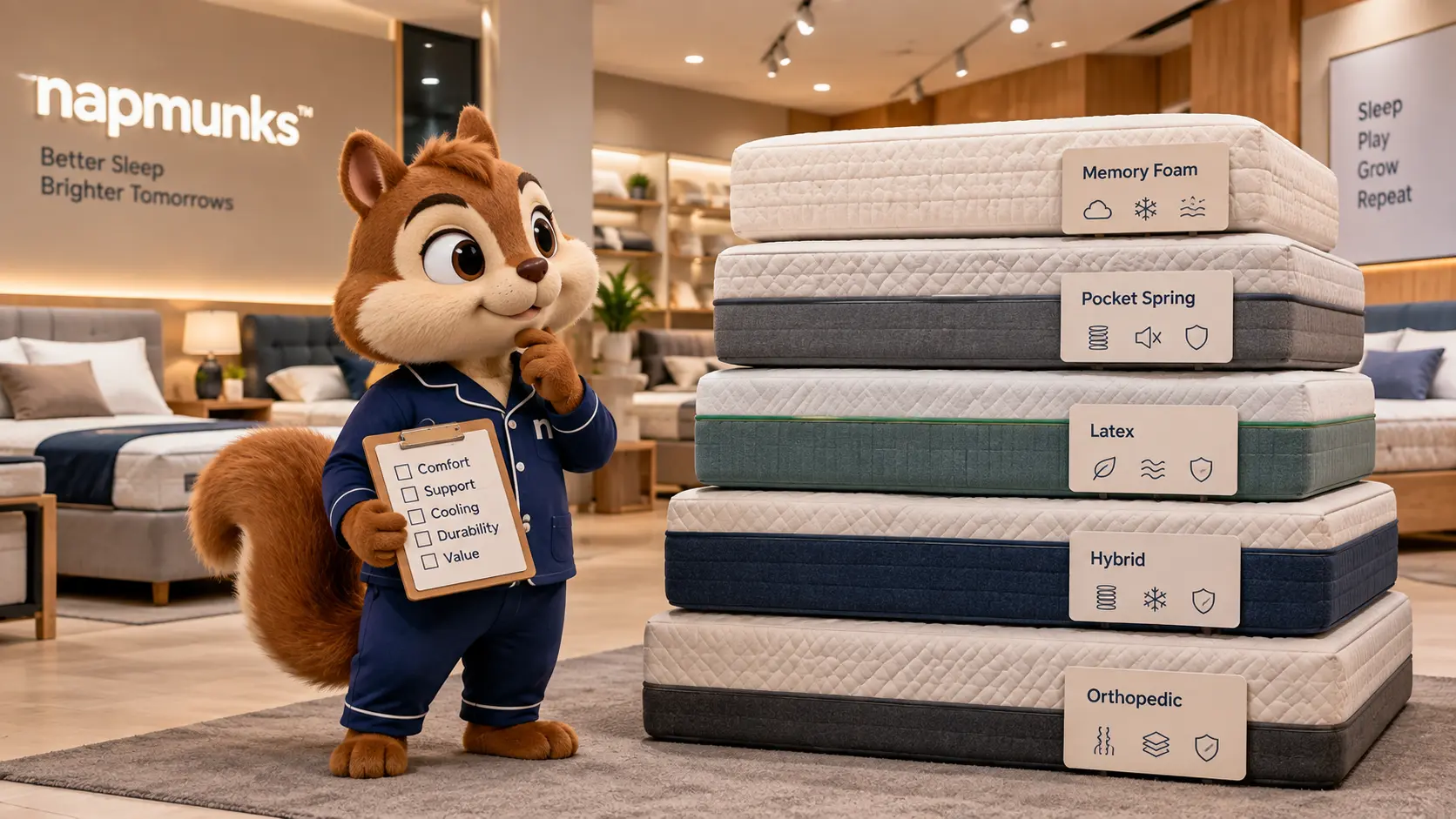
A mattress may look simple from the outside, but what happens inside determines how it feels, how it supports your body and how it performs over time.
Today, mattress buyers have more choices than ever. There are traditional foam mattresses, memory foam mattresses, latex mattresses, hybrids, cooling mattresses and technology-focused sleep products. With so many options, simply saying that a mattress is "premium" is no longer enough.
The more important question is:
What actually makes one mattress manufacturer different from another?
At Napmunks, the answer begins much earlier than the finished mattress. It starts with foam, material selection, mattress engineering, technology and manufacturing, and brings these elements together to create sleep products around specific sleep requirements.
Napmunks describes its approach as combining modern sleep science, smart materials, zoned support and cooling technologies across its mattress range.
Explore the Napmunks Mattress Collection
The Difference Starts With What Is Inside the Mattress
When comparing mattress brands, it is easy to focus on the outer fabric, thickness, appearance or even the number of layers.
But layers alone don't make a mattress better.
Each layer needs to have a purpose.
Foam can influence:
- Comfort
- Support
- Pressure distribution
- Resilience
- Motion response
- Durability
- Temperature management
Napmunks' manufacturing philosophy places significant emphasis on foam and material engineering rather than treating foam as simply a filling material. Its manufacturing content explains how foam characteristics and manufacturing consistency influence the performance of a finished mattress.
This is where the difference between putting materials together and engineering a mattress becomes important.
Foam Technology Is at the Core of Mattress Performance
Not all foam behaves in the same way.
Different foams can have different characteristics in terms of softness, resilience, pressure response, recovery and support.
A mattress designed for plush comfort may require a different foam combination from one designed around structured support. Similarly, a cooling mattress may require materials and construction that help manage heat and airflow.
This is why Napmunks works with different material combinations across its mattress range.
The objective isn't simply to make a mattress softer or firmer.
It is to create a combination of:
Comfort + support + responsiveness + durability + the right technology for the intended sleep experience.
Manufacturing and Assembly Under the Same Roof
One of the important aspects of Napmunks' manufacturing approach is the connection between its foam/manufacturing expertise and the finished sleep product.
Napmunks is supported by the manufacturing capabilities of Parshva Mattress & Foam, with its manufacturing facility listed in Dhaniv, Vasai East, Vasai-Virar, Maharashtra.
This creates a more direct connection between:
Material → Foam → Mattress Engineering → Assembly → Finished Product
That connection matters.
When manufacturing knowledge and mattress construction are closely connected, product development can be approached from the inside out — starting with what the material needs to achieve and then building the mattress around that requirement.
Instead of beginning with a marketing label such as "premium mattress," the focus can remain on what the construction is designed to do.
From Foam Manufacturing to Sleep Innovation
Napmunks isn't built around the idea that every sleeper needs the same mattress.
Different people have different requirements.
Some sleep hot.
Some prefer responsive surfaces.
Some want structured support.
Some prefer more cushioning.
Some want pressure-relieving comfort.
This is why Napmunks has developed different mattress constructions using different combinations of foam, latex, cooling technologies and support systems.
Its product range includes mattresses such as NapAlign, NapBreeze, NapCalm, NapChill, NapRelief and NapSense.
Read How Napmunks Connects Foam Manufacturing With Sleep Innovation
Technology Should Solve a Sleep Problem
One of the biggest differences between modern mattress engineering and simply adding features is purpose.
Technology should solve something.
For example:
Sleeping Too Hot
A cooling system should be designed to help manage temperature and reduce heat retention.
NapBreeze uses dual cooling technology, Smart Regulator PCM, a 7-zone organic latex support layer and airflow-oriented construction.
Need More Structured Support
A mattress designed around support needs to distribute body weight appropriately while maintaining stability.
NapAlign uses a 5-zone alignment support system with adaptive support layers and a stable base.
Want a More Responsive Comfort Feel
Latex can provide a different response compared with conventional foam.
NapSense combines a 10mm latex quilt layer, soft foam and a 7-zone latex support core, along with its Deep Sense massage surface technology.
Looking for Cooling + Contouring
NapChill combines two cooling layers with PCM, memory foam, a hybrid layer and a 5-zone support system.
This is the philosophy behind technology-led mattress manufacturing:
The technology has to serve the sleeper.
Zoned Support Instead of Uniform Support
Another important development in modern mattresses is zoned construction.
Your shoulders, hips, back and legs do not necessarily need exactly the same type of support.
Zoned systems allow manufacturers to engineer different areas of the mattress for different parts of the body.
Napmunks uses zoned support across multiple products.
For example, NapAlign uses 5-zone alignment support, while NapBreeze uses 7-zone organic latex support.
This is one of the ways mattress engineering has moved beyond the simple idea of choosing between "soft" and "firm."
Cooling Is Engineered Into the Mattress
Cooling is another area where mattress technology has changed considerably.
A mattress that feels comfortable in a showroom may feel very different after several hours of sleep, particularly for people who tend to sleep warm.
Modern cooling-focused mattresses can use a combination of:
- Temperature-regulating materials
- PCM technology
- Breathable layers
- Latex
- Airflow-oriented construction
- Layer combinations designed to reduce heat retention
NapBreeze, for example, combines PCM regulation, cooling technology, organic latex and breathable construction.
NapChill similarly uses PCM and dual cooling layers alongside memory foam and hybrid support.
Read: Cooling Mattresses Explained
Why the Quality of Foam Matters
A mattress can have an impressive-looking cover and a long list of features, but the materials underneath still matter.
Foam characteristics influence the way a mattress responds to body weight and movement.
Important factors can include:
- Density
- Resilience
- Recovery
- Compression behaviour
- Structural consistency
- Durability
Manufacturing consistency is particularly important because even a well-designed mattress depends on materials being produced and assembled consistently.
Napmunks' foam-focused manufacturing content discusses the importance of density, resilience, material formulation and quality testing in foam production.
Read: What Makes High-Quality Foam Different From Ordinary Foam?
It's Not Just About Having More Layers
A common assumption is:
More layers = better mattress.
But that's not necessarily true.
A mattress with multiple layers still needs to have those layers work together.
For example:
A comfort layer needs to provide the intended surface feel.
A transition layer can influence how the body moves from the comfort surface toward the support structure.
The support core needs to provide the required foundation.
Cooling materials need to work within the overall construction rather than being added as an isolated feature.
This is why mattress engineering is about layer interaction, not simply layer count.
Napmunks Builds Different Mattresses for Different Problems
Instead of treating every sleeper the same, Napmunks' product range addresses different combinations of comfort and support requirements.
For example:
NapAlign → structured alignment and support
NapBreeze → cooling + zoned latex support
NapChill → temperature regulation + hybrid support
NapSense → responsive latex + layered comfort
NapRelief → pressure-focused comfort and support
NapCalm → cushioning + stable support
This product differentiation is central to Napmunks' approach to modern mattress development.
A Mattress Manufacturer With a Complete Sleep Ecosystem
Napmunks doesn't stop at mattresses.
The brand also develops pillows and comforters, allowing it to approach sleep as a complete environment.
Its pillow range includes products designed around different height, support and comfort requirements, while its comforter is designed around lightweight warmth, breathable construction and temperature-balanced comfort.
Explore Napmunks Pillows and Sleep Products
This matters because the mattress is only one part of the sleep setup.
Your pillow affects head and neck positioning.
Your bedding affects warmth and temperature.
Your mattress affects support and comfort.
A sleep-focused brand can therefore look at these products as interconnected parts of the same experience.
What Actually Makes Napmunks Different?
So, when comparing Napmunks with other mattress brands, the difference isn't simply one feature.
It is the combination of several elements:
1. Foam Expertise
Foam is treated as an important part of mattress engineering, with attention to material characteristics and performance.
2. Manufacturing Foundation
Napmunks is supported by the manufacturing expertise of Parshva Mattress & Foam, connecting foam manufacturing knowledge with finished sleep-product development.
3. Manufacturing + Mattress Construction
The manufacturing process and finished mattress construction are closely connected rather than treating mattress development as purely a retail exercise.
4. Technology-Led Products
Cooling, PCM, zoned support, latex, memory foam and hybrid construction are used across different products based on intended sleep requirements.
5. Problem-Specific Design
Instead of one universal mattress, the range provides different constructions for different comfort and support preferences.
6. Complete Sleep Products
The brand extends beyond mattresses into pillows and comforters.
7. Focus on Engineering
The emphasis is on what happens inside the mattress — materials, layers, support systems and technology — rather than only the appearance of the finished product.
Why This Matters When Choosing a Mattress Brand
When you're comparing mattress brands, don't only ask:
"Which mattress feels softest?"
Ask:
- What is inside the mattress?
- What type of foam is being used?
- How is the foam engineered?
- What is the support structure?
- Is the mattress zoned?
- Does it have temperature-management technology?
- What problem is the mattress designed to solve?
- Who manufactures it?
- How is the mattress constructed and assembled?
- Does the manufacturer have experience with the materials being used?
These questions help you look beyond marketing terminology and understand the actual product.
From Manufacturing to the Mattress You Sleep On
The journey of a mattress starts long before it reaches your bedroom.
It begins with materials.
Then comes foam production and selection.
Then comes mattress design.
Then layering.
Then assembly.
Then finishing and quality checks.
The final mattress is the result of all those decisions working together.
Napmunks' manufacturing approach is built around this connection between foam manufacturing, mattress engineering and sleep innovation.
Read: From Raw Materials to Finished Mattress
The Future of Mattress Manufacturing Is More Personalised
The mattress industry is moving beyond the idea that everyone needs the same type of sleeping surface.
People have different:
- Sleeping positions
- Temperature preferences
- Comfort preferences
- Support requirements
- Body profiles
- Sleep environments
That means mattress manufacturing is increasingly about engineering different solutions for different sleepers.
Napmunks' range reflects this approach through different combinations of foam, latex, cooling technology, zoning and support systems.
And that is ultimately what makes a modern mattress different:
Not simply what it looks like from the outside, but how intelligently everything inside it works together.
Frequently Asked Questions
What makes Napmunks different from other mattress brands?
Napmunks combines foam and manufacturing expertise with technology-focused mattress construction. Its range uses technologies such as zoned support, cooling systems, PCM, latex, memory foam and hybrid construction across different products.
Does Napmunks manufacture its own foam?
Napmunks' brand content states that its manufacturing foundation is supported by Parshva Mattress & Foam and discusses foam manufacturing as an important part of its product-development process.
Why is foam technology important in a mattress?
Foam can influence comfort, support, pressure response, resilience, durability and motion response. Different foam characteristics can therefore be combined to create different mattress experiences.
What is zoned support in a mattress?
Zoned support divides the mattress into different support areas so that different parts of the body can receive different levels or types of support. Napmunks uses 5-zone and 7-zone constructions across different mattress models.
Does Napmunks make cooling mattresses?
Yes. NapBreeze and NapChill are examples of Napmunks mattresses built around temperature-management technologies. NapBreeze uses PCM and cooling technology, while NapChill combines PCM with dual cooling layers.
What is the difference between traditional foam and engineered mattress construction?
Traditional mattress construction may focus primarily on a general comfort category, whereas engineered construction can combine different materials and support zones to target specific requirements such as cooling, pressure distribution, responsiveness and alignment.
Which Napmunks mattress should I choose?
The right model depends on your individual sleep requirements. NapAlign focuses on structured support, NapBreeze on cooling and zoned latex support, NapChill on cooling and hybrid construction, while NapSense combines latex support with responsive comfort. You can explore the full range before deciding.
Explore the Full Napmunks Mattress Range
Final Thoughts
The difference between mattress brands isn't always visible from the outside.
It can be found in the foam, materials, engineering, manufacturing process, assembly and technology that sit underneath the surface.
Napmunks brings these elements together through a manufacturing-led approach supported by Parshva Mattress & Foam, while developing different mattress technologies around real sleep requirements.
From zoned latex support to pressure-relief foam, from PCM cooling to hybrid construction, the focus is on building mattresses where technology has a purpose.
Because the future of mattresses isn't simply about making them softer, thicker or more expensive.
It's about making them smarter.